

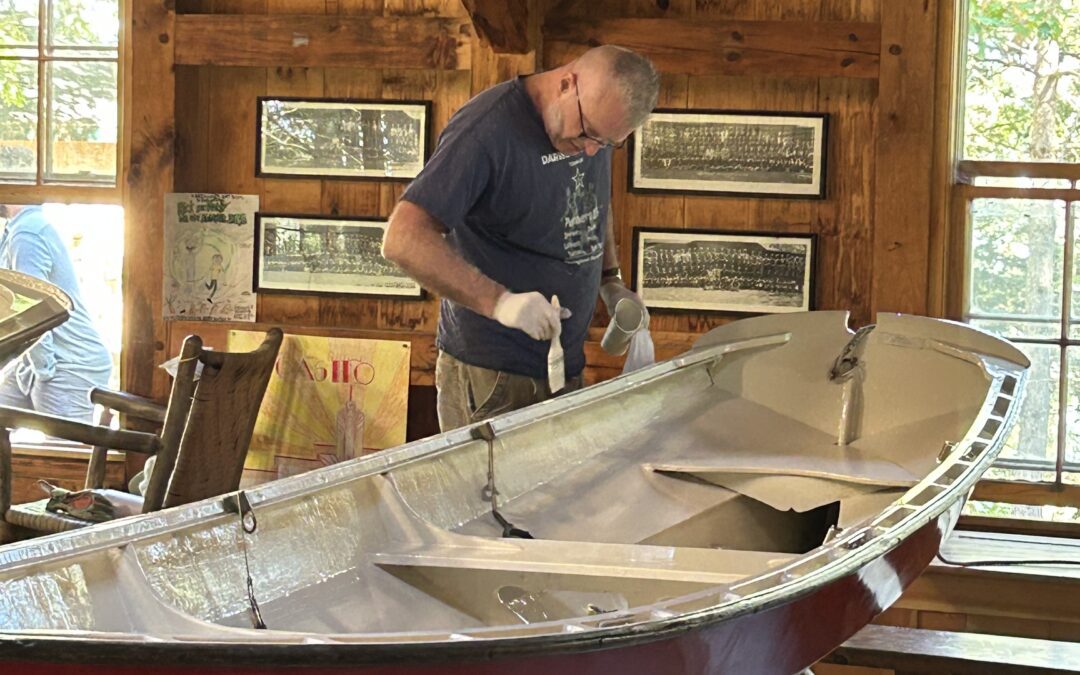
Volunteer Whit Fisher gives one of the Stimson dories a fresh coat of paint.
By Sam Lanoff
Every year, some six weeks after the Farewell Feed, a number of staff, alumni, parents—and even some especially brave significant others—return to Pine Island to help repair and maintain the camp’s fleet of wooden boats, the lifeblood of its waterfront activities. This September, I left the serenity of my yuppie Washington, DC apartment to take part in this tradition for the first time.
My journey began at Union Station, a few blocks from the Capitol Building, riding to New York’s Penn Station and then trekking (with a somewhat out-of-place Everest-equipped hiking pack) across town to Grand Central. I rode out to suburbia to spend the night with my parents, rented a car the next day, and some 500 miles and 30 hours after departing Washington, I found myself at the end of the Camp Road with an hour of daylight to spare.
I stepped onto the mainland dock, where I had gazed out at the waters of Great Pond many times before, boarded the KWS with Alex Toole at the helm, and soon pulled up to the kitchen dock, the only dock still in place. I unpacked in North Hampton, where I had lived as a camper 11 years prior, and unzipped my sleeping bag for the first time in nearly as many years.
As I roamed the island, I was struck by a familiar sense of creature comfort, similar to the way I once felt returning to a platform tent after days or weeks out traversing the mountains and waterways of New England. And yet there were obvious differences; when we entered the Dining Hall for dinner, the only light came from the fireplace and kerosene lanterns.
By 7:30 the next morning, a group of former Kitchen Crew had already prepared the second of five five-star meals. After some opening instructions from Alex, we proceeded down to the dock to greet our day-laborer volunteers, and with my ears still full of water from 100% dip, I followed the group up the Ridge. Shielded by long pants, hiking boots, and Covid-style masks, we took stock of the fleet: the Cove Boat, Mr. Batty, and the legendary Stimson dories in Honk Hall, the Bezumarang sailboats on the Honk lawn, the war canoe in the Dust Court, and the mast-less Catboats in the Boathouse.
Our wrangler for the weekend, Cody Smith, had always been one of my favorite counselors, but I hadn’t seen him since 2013, when I’d been his caller at West Gate. 12 years later, I was relieved to learn that I hadn’t given him any permanent hearing damage.
At Cody’s meticulously planned direction, we commenced sweeping out (and sometimes, rather sheepishly, vacuuming out) the cobwebs, dust, and pine needles that had accumulated in the dories. Once the debris had been cleared, working in teams of two or three, we began sanding the interior surfaces with the same care and rigor that the artisans applied to their restoration of Notre Dame Cathedral. With time and elbow grease, progressing from 150-grit sandpaper to 400 and then 600, the splinters and rough patches gradually receded. We passed the time discussing school, work, travel, and the artistic merits of the numerous Saturday Night Show posters adorning the walls—my favorite being PineTanic, in which I’d had a small role as a first-year camper.
Once the wood was smooth to the touch, we secured painter’s tape along the straight edges and formed dozens of small fragments into a mosaic of overlapping pieces to follow the curves of the dories’ distinctive colored stripes. Then, taking the cup of Benjamin Moore paint that Cody had parceled out, I began to paint the exterior of the George, only to quickly learn that when it comes to paint color, cream is not the same as white. Fortunately, I only had to repaint the dories a few times.
After a full day of sanding, painting, and pleasant conversation, it was nearly time for dinner. I walked down to the Boathouse ramp, taking in the views and remembering how at age 11, at that very spot, I was convinced by a counselor that the island had become detached from its moorings and was drifting slowly but surely towards Oak Island, making it imperative that my tent go to sleep early so the counselors could don SCUBA gear for a daring nighttime reattachment operation.
In the evening, we gathered for a campfire. Although scenic, it lacked the traditional musical elements, since someone who shall remain nameless had recently snapped the camp guitar’s high-E string. Still, watching at the flames and the starry night sky, which is particularly clear in the fall, it felt like an appropriate coda to our time on the island.
The next morning, we woke with the sun beaming horizontally into North Hampton and began the day with another brisk 100% dip. For the second or third time, I mentioned to Alex that even under his new management, PIC was apparently still too stingy to install a single heater in the lake.
After breakfast, we finished sanding the buoys while admiring our prior days’ handiwork; the fleet looked pristine.
After saying our departing Akka Lakkas, I was ferried back to the mainland and started on my way back down I-95.
Throughout the long drive home, I reflected on how, with just a little rekindling, my friendships and memories of camp could be set ablaze. Who says you can’t go home again?
This article was originally published in the February 2026 edition of The Pine Needle.